
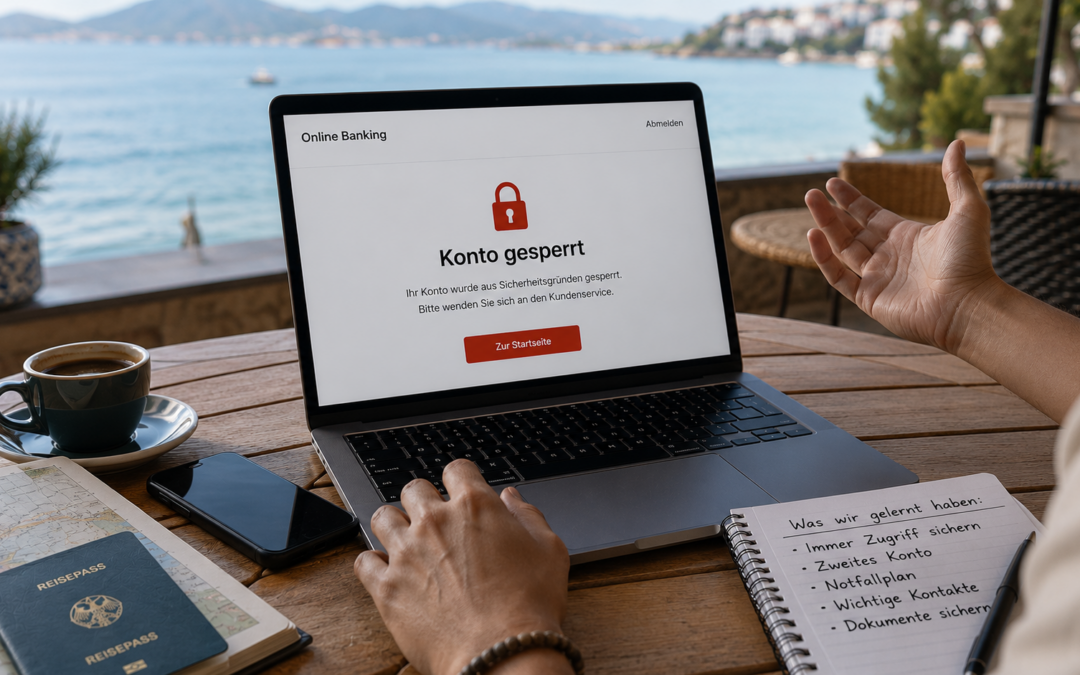
In the middle of being abroad, everything suddenly stopped working: our Wise account was blocked, all our funds frozen. In the first moment it was a shock — we didn’t know the process yet, and had no idea whether everything would really sort itself out smoothly in the end. What happened over the following days, and what we do differently since, is what we’re telling here.
The First Shock: Funds Frozen
Without warning, the account was blocked, no more access to the funds. Luckily, it turned out less severe than we feared in that moment: payments already on their way from clients were automatically sent back to the senders. The existing balance was paid out to another one of our accounts a few days later. Wise’s support actually worked well here — without that, those days would have felt considerably longer.
Telling Clients: Uncomfortable, But Necessary
What the system doesn’t resolve on its own: payments that were still due to come in. For those, we had to reach out to our clients directly and ask them to transfer to a new account number. Not a pleasant conversation — you have to explain what happened. It might not have been strictly necessary in every case, but our client relationships run on trust, and that’s exactly why being upfront mattered more to us than a smooth excuse.
The Search for an Alternative
Far more pressing than talking to clients was the question: now what? We needed a working alternative fast — and that’s anything but trivial when your company isn’t based in Germany. Not every bank is even an option then.
Edge cases like ours rarely show up in the FAQs. Several times we opened an account only to find out afterward: doesn’t work, because some document was missing that simply couldn’t be obtained for our situation. So close it all down again and start over.
What We Learned From This
The most important lesson: run several accounts in parallel, both business and personal. If one gets blocked, you stay able to act immediately through the others — instead of only learning how a blocking process actually works once it’s an emergency.
This applies regardless of being abroad, by the way. Even domestically, accounts can be unexpectedly cancelled or frozen through no fault of your own. Foresight pays off either way — what matters is staying able to act immediately, instead of being caught flat-footed.
One point many people overlook: every new account opening affects your credit score, usually temporarily but noticeably. It’s worth not opening all your accounts at once right before a trip abroad, but spreading them out over time. And: the longer an account has existed, the more positively it counts — the age of a banking relationship signals a stable, long-standing relationship.
Which accounts we kept after this experience and which ones we deliberately dropped is covered in detail on our Accounts page. Want to think through your own backup plan? Get in touch.
As of July 2026. Personal experience report, supplemented with general information on credit scores (including the age of a banking relationship, the impact of new account openings) — not financial or legal advice. Terms vary by provider and change over time; clarify your specific case directly with your bank.
© Image: Generated with AI